Picking between the best platforms to build an ecommerce website is the decision most beginners spend three weeks on, and twenty minutes on the product page. I understand why. It is the choice you can compare on a pricing page. But I have watched stores on all three of these do well, and watched stores on all three fail for reasons that had nothing to do with the software.
So here is the comparison I give clients, including where the honest answer is none of them.
Shopify is the default for a reason
Hosted, stable, and the ecosystem is wider than anyone can track. Payments, tax, themes and shipping are already solved by someone else, for a monthly fee.
What I like about it is dull and specific. The checkout does what the docs say it will. GTM drops in without a fight, the web pixel and customer events APIs are documented, and server-side work is possible without hacking core files. Elsewhere I lose the first day to whatever the theme broke.
What I don't like is the bill. Base plan, then apps, then apps to fix the apps. External payment gateways also add a transaction fee, which surprises people arriving from WooCommerce.
Best fit: someone who wants to sell this month without a server to think about. Most dropshipping stores land here and stay.
WooCommerce buys you control and hands you the upkeep
WordPress plus WooCommerce means you own the database, the code and the hosting account. Nobody can raise your rent or switch off a feature you depend on. That matters more once a store is earning.
The trade is maintenance. Updates, backups, security patches, caching. A plugin conflict can take the checkout down on a Saturday with no support queue to join. You learn enough to fix it or you pay somebody who does.
Where it wins for my clients is content. If articles are how people will find you, having the blog and the store on one install beats running two systems that pretend to talk to each other. Tracking is flexible too, since you can edit templates and server code directly. That cuts both ways. I have inherited more broken WooCommerce tracking than broken Shopify tracking, usually because somebody pasted a tag into a theme file years ago and forgot.
Wix and Squarespace get you live by the weekend
Drag, drop, publish. Templates look decent out of the box, hosting is included, and you will not spend an evening on SSL certificates.
The ceiling arrives quietly. Product options get awkward once you need more than a couple of variants, and multi-currency, complicated shipping and subscriptions are where these builders start saying no. Tracking is the weak spot I run into most: the checkout is a walled garden, so some events are blocked and consent tooling has less room to work.
Small catalogue, a service business selling a handful of items, a weekend test of whether anyone wants the thing. All fine. A store you intend to grow for five years is another matter, because you will end up moving, and moving is the expensive part.
Side by side
| Shopify | WooCommerce | Wix / Squarespace | |
|---|---|---|---|
| Setup time | Days | One to two weeks | Hours |
| Monthly cost | Plan plus apps | Hosting plus plugins | Plan |
| Maintenance | Platform | You | Platform |
| Customisation ceiling | High | Very high | Low |
| Tracking setup | Well documented | Well documented | Limited, sometimes blocked |
| Migration risk | Medium | Low, you own the data | High |
The cost that never makes it into the spreadsheet
Shopify stores I audit usually run ten to fifteen apps. Each adds a subscription, a script tag and latency, and together they slow the store in ways nobody measures until conversion drops.
Two rules keep this honest. An app has to replace work you actually do every week, not work you might do someday. Every app gets reviewed after two months, and if it has not earned back its fee it goes. I have removed apps charging for a feature the platform had started shipping for free.
What no platform will fix
The list I wish more people read before picking a plan.
- A product nobody wants. Software cannot manufacture demand, and no theme rescues a weak offer.
- Broken tracking. Every platform needs the same GTM work, and the checkout provider does not do it for you. If you are on Shopify, start with GA4 setup.
- Slow pages. Themes and apps cause this far more often than hosting does.
- Offers that do not add up. Pricing, shipping thresholds and returns are decisions you make, not settings you toggle.
Migration is the bill you pay later
Switching costs more than the monthly difference, every time. Choose with the exit in mind, even if you never take it.
Products export from all three, but variant structures differ and remapping is a day of tedious work. Customers and orders come out of Shopify and WooCommerce cleanly; Wix gives you less. URLs are the part people forget. Every product and collection address needs a 301 redirect, or the search traffic you spent a year building evaporates. Apps mostly do not migrate, so plan to rebuild the tracking layer.
A Wix to Shopify move means a new theme, new apps and new URLs, so three rebuilds instead of one. WooCommerce to Shopify keeps the data and often the URLs, which is why content-heavy businesses hesitate to leave.
How I would decide in twenty minutes
- No developer, and no appetite to become one? Shopify, or Wix if the catalogue is tiny.
- Content is how people will find you? WooCommerce, or Shopify with the blog switched on.
- Proving demand before spending real money? Wix or Squarespace, and accept the move later.
- Subscriptions, multi-currency or messy shipping rules within a year? Shopify or WooCommerce.
- Compliance or a custom integration needs code-level access? WooCommerce.
Where I would put my own money
Shopify, for most people reading this. Not because it is better software, but because it removes the failure that kills beginner stores: the store that is nearly finished and never opens. The fee is real, and I would still rather you pay it than spend four months on something you are too tired to launch.
The exception is a content-led brand with someone technical around. There, WooCommerce earns its keep through flexibility, and ownership justifies the upkeep. I would not start on Wix unless the goal is a test, and better to hear that before the theme gets chosen.
Then stop comparing. A store you can launch this week beats a better one you launch in March. Once it exists, the work that moves the needle is getting the first customers and making sure the conversion data is trustworthy.
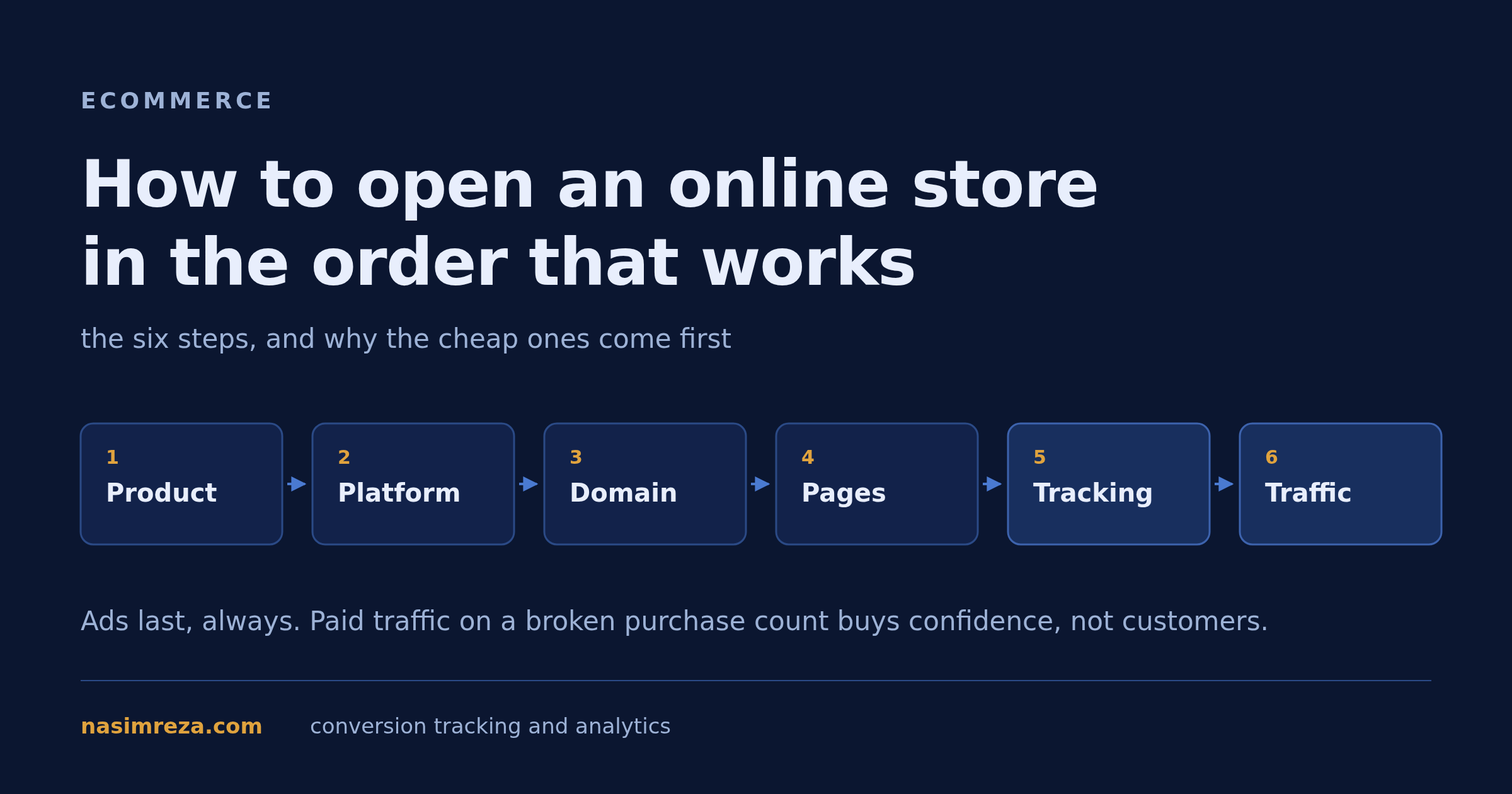
Platform is only step two. If the rest of the sequence is still open, the order I set a store up in covers domain, pages, tracking and traffic in the order that keeps the cost down.
If you are launching and want the tracking built properly from day one, packages start at $1,250 and include a read-only audit of what you have now. If you only have one question, book a 15-minute call for $19 and ask it.